2026 How to Use Cold Rolled Steel in Construction Projects?
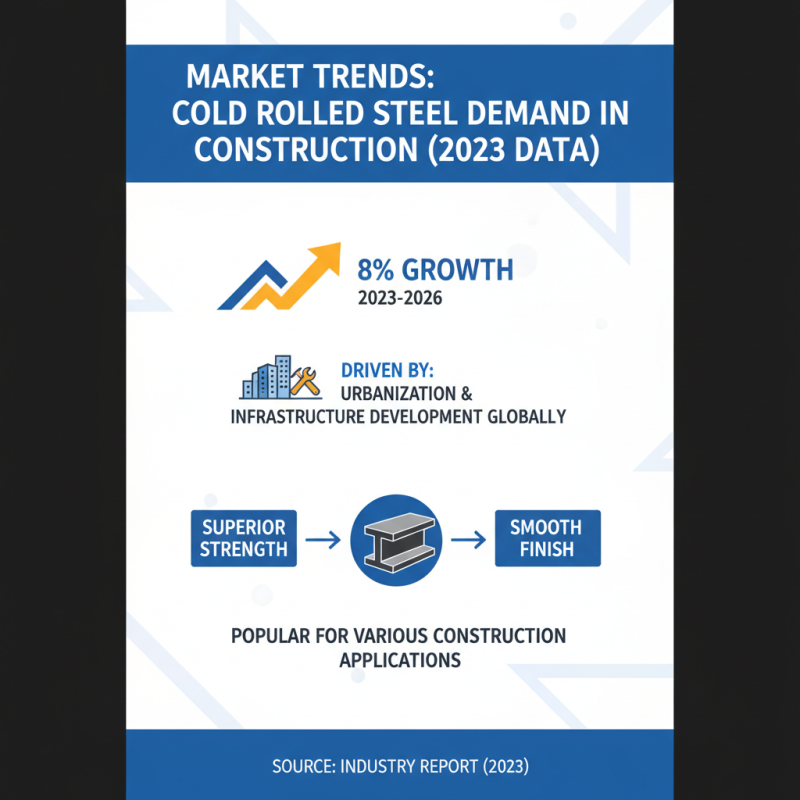
Cold Rolled Steel is a vital material in construction. Its unique properties make it suitable for various applications. According to the World Steel Association, cold rolled steel accounts for over 20% of the global steel market. This material is thinner, stronger, and more precise than hot-rolled counterparts. Its surface finish is smoother, which is essential for aesthetic and structural purposes.
Construction projects increasingly demand efficiency and sustainability. Cold Rolled Steel meets these needs by minimizing waste and improving structural integrity. Reports indicate that buildings using cold-rolled sections can reduce overall weight by up to 30%. However, challenges exist. Not all contractors fully understand its properties. Misapplication can lead to material weaknesses. It's essential to educate teams on its proper use.
Moreover, cost efficiency plays a role. While cold rolled steel may have a higher upfront cost, its long-term benefits are undeniable. The National Institute of Standards and Technology recommends using cold rolled steel for its energy efficiency in structural systems. Awareness and expertise are crucial for maximizing its potential. Adapting to this material requires careful planning and consideration.

Understanding Cold Rolled Steel: Definition and Properties
Cold rolled steel is a crucial material in modern construction. Defined as steel that has been processed at room temperature, its unique features set it apart from hot rolled steel. This method enhances strength and provides a superior finish. According to industry reports, cold rolled steel has a tensile strength ranging from 250 to 550 MPa, making it suitable for structural applications.
The production process involves cold working, which increases steel's hardness and improves its yield point. However, while this increases strength, it can also increase brittleness. This characteristic can lead to challenges, such as cracks under stress, especially in design phases that overlook stress distribution. Notably, the elongation percentage can be lower than that of hot rolled steel, at approximately 10% to 20%.
Considering these attributes is vital when deciding how to use cold rolled steel effectively. Structural engineers must balance material choices with design requirements. There is little room for error in specifications. Accurate calculations are necessary since oversights could compromise safety or lead to costly modifications during construction. Overall, understanding these properties aids in selecting the right application for cold rolled steel in building and infrastructure projects.
Cold Rolled Steel Properties Comparison
This chart illustrates key mechanical properties of cold rolled steel, presenting its yield strength, tensile strength, elongation percentage, and hardness. Understanding these properties is essential for effectively incorporating cold rolled steel into construction projects.
Benefits of Using Cold Rolled Steel in Construction Projects
Cold rolled steel is gaining popularity in construction projects due to its multiple advantages. According to a 2021 report from the American Institute of Steel Construction, cold rolled steel can improve structural integrity and reduce material waste. Its uniform thickness enhances performance, making it a reliable choice for beams and sheeting.
This type of steel has a stronger surface finish compared to hot rolled steel. It allows for easier painting and coating, thus improving aesthetic appeal. A study by the Steel Construction Institute highlighted that cold rolled steel framing could lower construction time by up to 20%. However, some may argue that the initial cost can be higher, which can be a concern for budget-conscious projects.
Moreover, cold rolled steel is recyclable, promoting sustainability in construction. It helps reduce the carbon footprint of buildings. However, handling cold rolled steel requires careful attention during installation. Improper handling can lead to deformities that compromise usability. Balancing its benefits with the challenges ensures that projects maximize the potential of this material.
2026 How to Use Cold Rolled Steel in Construction Projects? - Benefits of Using Cold Rolled Steel in Construction Projects
| Dimension |
Description |
Benefits |
Common Uses |
| Thickness |
The thickness of cold rolled steel typically ranges from 0.8 mm to 3 mm. |
Provides high strength-to-weight ratio. |
Used in light structural applications. |
| Yield Strength |
Cold rolled steel has a yield strength of around 250 MPa to 550 MPa. |
Allows for thinner materials without sacrificing strength. |
Suitable for frames in buildings and bridges. |
| Surface Finish |
Cold rolled steel surfaces are smooth and have a clean finish. |
Enhances aesthetic appeal and paint adhesion. |
Used in decorative panels and facades. |
| Cost Efficiency |
Cold rolled steel is generally more cost-effective compared to hot rolled steel for similar applications. |
Reduces overall project costs. |
Used in industrial and commercial construction projects. |
| Corrosion Resistance |
Cold rolled steel can be treated for enhanced corrosion resistance. |
Increases longevity and maintenance intervals. |
Applicable in outdoor constructions and marine environments. |
Applications of Cold Rolled Steel in Modern Construction Techniques
Cold rolled steel plays a crucial role in modern construction techniques. This material is known for its
superior strength and precision. Builders often use it for structural beams and frames due to its
durability. Its smooth surface makes it ideal for aesthetic applications as well. Architects appreciate
the versatility of cold rolled steel in various designs. The material can be formed into intricate shapes, enhancing visual appeal without compromising strength.
In industrial settings, cold rolled steel also finds its place in building facades. The sleek finish allows for modern aesthetics. However, one must consider
the potential for corrosion. If not properly treated, the longevity of these steel elements may suffer.
Designers should evaluate environmental factors before deciding on its use.
Additionally, while cold rolled steel is cost-effective, it may require more precise fabrication techniques.
This could lead to increased labor costs if not managed well. Balancing the benefits and challenges is key in construction projects.

 Angle Steel
 Channel Steel
 Universal Beam (l-Beam)
 H-Beam Steel
 Galvalume Steel Coil
 Galvalume Steel Sheet
 Galvanized Steel Sheet
 Color Coated Plate
 Stainless Steel Bar
 Stainless Steel Pipe
 Steel Bar
 Wire Rope
 Carbon Steel Pipe
 Carbon Steel Plate
 Aluminum Plate
 Aluminum Coil
 Aluminum Pipe
 Aluminum Bar
 Magnesium Ingot
 Fasteners